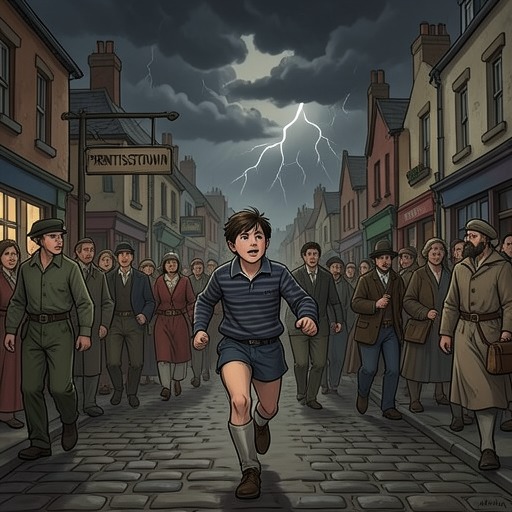
Prentisstown’s age-thirteen threshold for adulthood
The Knife of Never Letting GoPrentisstown’s age-thirteen threshold for adulthood makes Todd’s thirteenth birthday more than a personal milestone: it is a social rule that measures his status, a countdown he cannot ignore, and a point around which Prentisstown’s plans appear to turn. The rule is presented both as an old custom of the New World and as a practical answer to the demands of a small, isolated society. For Todd, however, its approach raises a harder question than when adulthood begins: what sort of person is he expected to become when it does?
The Rule and Its Boundary
The threshold divides boys from men at thirteen. Todd is the youngest boy in Prentisstown, and when he says he has twenty-eight days left, he is naming the time remaining before the law formally changes his status. At Hildy’s, that number does not persuade Matthew Lyle to treat him as a child: Matthew dismisses the days as meaningless. Hildy, by contrast, insists that the law applies to men and that Todd is not yet one. Her distinction gives the rule immediate practical force. Todd’s age affects how others classify him, but that classification is contested rather than universally respected.
The interval is not abstract. When Viola asks why the town is waiting for the last boy to become a man, Todd confirms that the birthday is twenty-seven days away. A later midnight leaves him twenty-five days from the threshold, a span he experiences as both measurable time and an almost impossible distance. The shrinking count gives the rule a recurring presence: adulthood is not a distant general idea but an approaching date whose meaning keeps changing as Todd learns more about the people and pressures surrounding him.
Explanations for Becoming an Adult
Todd describes the age-thirteen custom as something the New World has always done and says it is supposed to be scriptural. He recalls Aaron explaining it through the story of eating from the Tree of Knowledge: a passage from innocence into sin. That account casts adulthood as a moral fall, not simply a new set of duties. The threshold can therefore sound like a warning that knowledge and responsibility bring culpability with them.
Todd also recalls Ben giving a practical explanation. On an isolated planet, a small population needs adults, so thirteen is the age at which people begin taking on real responsibilities. The two accounts do not quite settle into one meaning. The scriptural explanation makes the threshold symbolic; Ben’s explanation makes it a social necessity. Together they show how a rule can be sustained by both inherited moral language and the material needs of a community. Todd reports both explanations, but he does not claim that either fully resolves what the rule means for him.
Todd’s Countdown and Prentisstown’s Plans
The date matters beyond Todd’s own standing. Viola connects the town’s apparent waiting to a plan that has been in preparation for years, saying it was awaiting the last boy in Prentisstown to become a man. She asks whether Todd is that boy; he confirms that he was the youngest. In this exchange, the threshold becomes part of a political timetable. Todd’s birthday is not merely when the community will recognize his adulthood: it appears to be a condition around which Prentisstown’s movement has been organized.
Viola warns that Todd does not know parts of their history and that knowing them could put him in danger. She identifies his innocence as his only chance of receiving a welcome, while pointing him toward his mother’s book for more information. The threshold thus sits between ignorance and knowledge as well as between boyhood and manhood. Todd is being told that his innocence may protect him, even as the approaching age is associated with responsibility, knowledge, and a plan he has not been allowed to understand. The rule becomes consequential precisely because its private calendar and the town’s larger history converge on the same person.
Adulthood as a Moral Test
As the days diminish, Todd measures himself against an expectation that is more violent than simply reaching thirteen. He thinks he must change because he cannot kill a man even when that man deserves it, and wonders how he could hold his head up if that inability remains. He connects his failure to kill Aaron with Aaron’s opportunity to tell Mayor Prentiss where he had last seen Todd. He also imagines that killing Mr Prentiss Jr at the farm could have prevented the consequences that followed for Ben and Cillian, and Manchee. These are Todd’s anguished counterfactuals, not proof that violence would have made him a better adult; their importance lies in how readily he treats killing as a test he has failed.
The age rule itself does not establish that adulthood means killing. Yet Todd’s fear of being unable to kill shows how the social meaning of manhood has reached him: he judges his moral reluctance as a weakness that must change before he can be a man. Against Ben’s account of responsibility, that belief raises a central tension in the rule’s meaning. Adulthood may demand participation in a community, but Todd has begun to equate it with the capacity for violence. The countdown therefore tracks not just an impending legal status but a conflict over which expectations he will accept as part of growing up. By the later midnight, he is still twenty-five days from the threshold, and its approaching date offers no simple answer to that conflict.